From Concept to MVP: How to build a DSCSA-Compliant Pharmaceutical Supply Chain Platform
Last Updated on
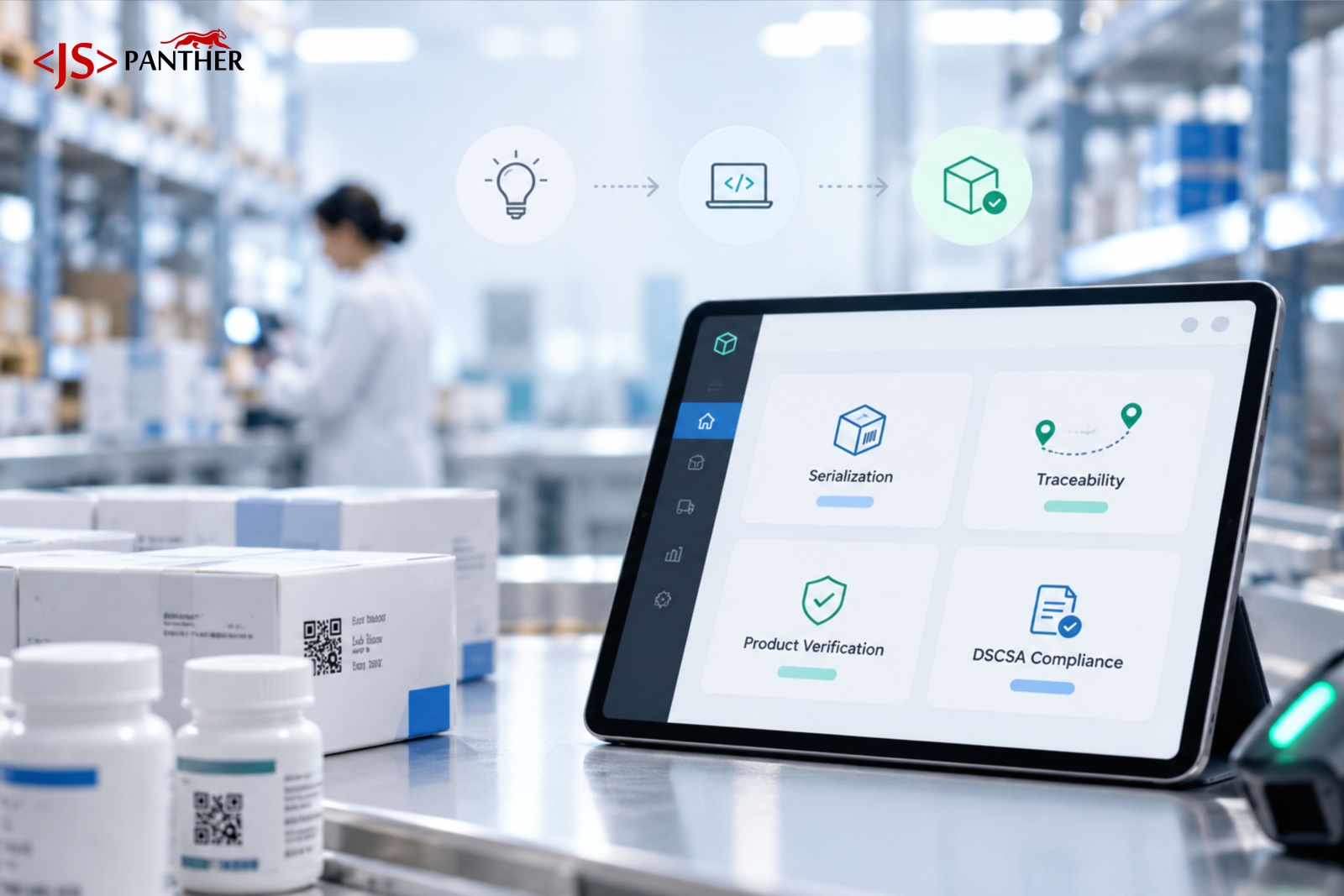
When a pharmacist hands over a prescription, someone should be able to prove where that medicine has been. A pharmaceutical traceability platform makes that possible. It’s software that tracks each package from manufacturer to pharmacy shelf and verifies it’s legitimate, as the Drug Supply Chain Security Act (DSCSA) requires in the US.
If you’re planning to build DSCSA-compliant software in USA, a smart first step is a focused MVP: a lean version that handles the core job well, so you can test it with real trading partners before you invest in the full system.
Trying to build every feature before launch is the quickest way to run out of time and budget. A better approach is to start small and get the core right. This guide covers what to build first, how the process unfolds, and the problems that usually show up. But first, a quick look at what we’re building.
What Is a Pharmaceutical Traceability Platform?
A pharmaceutical traceability platform is software that records, verifies, and shares the movement history of prescription drugs across the supply chain. Each saleable package gets a unique digital identity, and every handoff between manufacturers, wholesalers, distributors, and pharmacies is logged against it.
In practice, the system can answer questions like these in seconds:
- Where did this package come from?
- Who has handled it since?
- Is it genuine, in date, and free of any recall?
It is also termed pharmaceutical traceability software or a drug supply chain tracking system. The idea is simple. Doing it at scale, across dozens of trading partners with different systems, is the hard part.
Why Does the US Pharmaceutical Supply Chain Need Traceability?
The US pharmaceutical supply chain needs traceability for three reasons: regulation, patient safety, and operational value.
Regulation – The Drug Supply Chain Security Act (DSCSA) requires electronic, package-level tracing of prescription drugs, along with a way to verify product identifiers. FDA has phased enforcement for different types of trading partners, and deadlines have shifted along the way. And this makes pharmaceutical supply chain software USA essential.
Patient safety – With traceability, it becomes easy to catch products having issues, such as counterfeit, stolen, or contaminated drugs, before they reach a patient. Even when these cases are uncommon, the consequences are serious enough to justify a verification system.
Operational value – If a drug is recalled, you need to know which lots are affected and where they ended up. Package-level records make that much faster to find. Inventory is easier to manage when you can see where the product is present. Traceability data can also give teams a clearer view of demand over time. Compliance doesn’t have to be a pure cost.
How Do You Build a Pharmaceutical Traceability MVP?
Here are the steps you need to follow to successfully build a drug supply chain tracking system MVP:
Step 1: Understand who you’re building for
The pharma supply chain is too broad. It involves manufacturers, distributors, pharmacies, and regulators with different responsibilities. Picking a primary user and one main issue to fix is essential. Talking to the pharmacists, warehouse staff, QA officers, etc., can help you understand what can be the major problem to work upon.
Step 2: Map the regulatory requirements to features
Before a healthcare MVP development company starts designing the platform, identify the DSCSA requirements that apply to your users, including product identification, transaction records, product verification, and authorised trading partners. You need to seek assistance from a regulatory consultant before you write code. Skipping this step can leave you with the wrong product, fines, or a damaged reputation.
Step 3: Define the MVP scope
Build one complete core loop rather than a shrunken version of everything. For most teams, that loop is:
- Receive or create product data with serialized identifiers
- Record a transfer between two trading partners
- Exchange the required transaction data
- Verify a product identifier on request
- Flag and handle a suspect product
Analytics, AI, blockchain, and mobile apps for every role can wait. Sort each idea with MoSCoW prioritization (must-have, should-have, could-have, won’t-have) so nothing creeps in unnoticed.
Step 4: Design the data model and integrations
One manufacturer can produce millions of serialized packages a year, so the data model needs to handle volume from the start. Plan for the full aggregation hierarchy of package, carton, case, and pallet, even if you launch with only part of it. Aggregation lets teams scan a carton or pallet instead of every package.
Step 5: Design for the people who’ll use it
Keep workflows to minimal clicks, since adoption depends heavily on usability. If a tool slows people down, they’ll skip it. Start with wireframes, build a clickable prototype, and test it with warehouse staff and pharmacists. Pay attention to where they hesitate.
Step 6: Build in short cycles
Work on your medical supply chain management platform in short cycles or sprints. Keep tickets small. Use version control, CI/CD, and automated tests, and include checks on your compliance logic. Get the core loop working first. Add nothing else until it does.
Step 7: Test for security, compliance, and scale
Make sure data is encrypted in transit and at rest. Make sure audit logs capture every action. Role-based access should follow least privilege. Test error states and edge cases too. Then add penetration tests, vulnerability scans, and load tests. The load tests should confirm that logs stay intact and alerts still fire at realistic volume.
Step 8: Pilot with real trading partners
A few clinics or a single pharmacy location is enough. A pilot lets you check your assumptions before a wider rollout. Watch it closely, collect feedback, and expand step by step. Don’t stop after launch. New regulations, API changes, and user feedback will keep calling for updates.
Planning a DSCSA-compliant MVP?
We’ll help you scope your MVP and plan the right integrations.
Talk to Our Experts
What Features Should a Traceability MVP Include?
Here’s a simple way to split your feature list when building a prescription tracking software: what goes into the first release and what can wait.
Launch with
- Serialized product records: GTIN, serial number, batch/lot, and expiry date
- Trading partner management, so you know who’s authorized to exchange data
- Transaction data exchange between partners
- Product verification on request
- A suspect product workflow to flag and handle problem packages
- Role-based access and audit logs
- Basic reporting
Add later
- AI-based anomaly and counterfeit detection
- Blockchain-based records
- Demand forecasting dashboards and advanced analytics
- IoT and cold chain monitoring
- Mobile apps for every role
- Multi-region compliance
- Deep ERP and warehouse system integrations
If your software handles patient-related records, plan for HIPAA from the first sprint instead of keeping it for later. That means access controls, audit logs, and encryption from the start, and knowing exactly where protected health information is present in your system.
What Are the Most Common Challenges?
These are the issues that most often slow down a traceability build:
- Legacy systems – Many pharma companies still run older systems, and connecting them to a traceability platform is hard. Hospitals and distributors also run different versions of the same software. Sometimes the fix is wrapping APIs around the old system rather than replacing it.
- Data quality – Poor data hurts the whole platform. Expect schema mismatches, inconsistent naming, and missing metadata, and set up data governance early.
- Partner readiness – Third-party approvals and partner onboarding are some of the most common reasons you fall behind your schedules. Start those conversations early.
- Changing regulations – Requirements differ by country and keep evolving. Keep compliance in its own modular layer so a rule change doesn’t mean rewriting the system.
- Scope creep- Every “just one more feature” adds to your timeline and budget. Stick to your must-haves and sort new ideas.
Final Thoughts
Building a traceability MVP is mostly about deciding what to leave out. Keep the first release focused on one user and one complete loop, test it with a few trading partners, and let pilot feedback shape what comes next.
If you’re planning a pharmaceutical traceability MVP, JS Panther can help you define the scope, plan the right integrations, and build a solution that meets DSCSA requirements.
Frequently Asked Questions
How much does it cost to build a traceability MVP?
A US-focused Traceability MVP starts with basic to advanced versions depending on the problem you pick to solve. As it involves compliance with the DSCSA, it can cost somewhere between $40,000 and $120,000.
Does traceability data have uses beyond compliance?
Yes. With the right data design, the same records can support demand forecasting, inventory optimization, and faster recall response. It also varies according to the core objective of your software development.