MVP vs Prototype vs PoC: Which One Should You Build First?
A few months ago, a startup founder came to us with what sounded like a brilliant product idea.
He wanted to build an AI-powered logistics platform that could predict shipment delays, automate warehouse decisions, and optimize delivery routes in real time. The vision sounded exciting. Investors liked the pitch deck. The founder was already discussing scaling plans.
But during discovery discussions, one simple question changed the entire direction of the project:
“Has the core prediction engine actually been tested yet?”
Silence.
The team had already started discussing UI design, mobile apps, dashboards, and marketing plans. But nobody had verified whether the AI model could realistically process live logistics data with enough accuracy to make the platform useful.
That is where many startups go wrong.
Founders often jump straight into product development without understanding what they actually need first — a PoC, a prototype, or an MVP.
And honestly, this confusion is extremely common.
Many businesses use these terms interchangeably, even though they solve completely different problems. Understanding the difference early can save months of wasted development time, reduce risk, and significantly lower overall product costs.
Especially when working with an experienced or reliable MVP development company, choosing the correct starting point becomes one of the most important strategic decisions in product development.
So let’s break this down properly.
Why Startups Often Build the Wrong Thing First?
One of the biggest mistakes in early-stage product development is assuming the product journey always starts with a complete application.
It does not. Sometimes
- The real challenge is technical feasibility.
- User experience clarity.
- Market validation.
And each situation requires a different approach. This is exactly why the conversation around MVP vs Prototype vs PoC matters so much.
What is a Proof of Concept (PoC)?
A Proof of Concept (PoC) is the earliest validation stage in product development. Its purpose is simple: to check whether an idea is technically possible.
A PoC is usually built internally to test one major assumption, such as whether an AI model can process data accurately, whether a platform can handle real-time operations, or whether complex integrations will work properly.
This is where the discussion around MVP vs proof of concept becomes important. A PoC validates whether something can work technically, while an MVP validates whether users actually want it.
When Should You Build a PoC?
A PoC makes sense when:
- Technology is complex or uncertain
- Product depends heavily on AI, ML, automation, or integrations
- Development team is not sure about the technical feasibility
- Investors want technical validation before funding
- Ideas involve high-risk architecture decisions
What is a Prototype?
A prototype is an early visual representation of a product that helps businesses understand how the final solution may look and function. Unlike a PoC, which focuses on technical feasibility, a prototype focuses on user experience, workflows, and product interaction.
This is why the Prototype vs PoC discussion matters. A PoC validates whether the technology can work, while a prototype validates whether the product experience makes sense for users.
When Should You Build a Prototype?
Businesses usually build prototypes when:
- User journeys and workflows still need clarity
- Investors want a visual demonstration of the idea
- Teams need alignment before development begins
- Early usability feedback is important
- The product experience plays a major role in adoption
One major advantage of prototyping is that it helps identify UX and workflow issues early. Businesses often discover confusing navigation, unclear user flows, or missing interactions before writing production-level code. This is also where the discussion around MVP vs Prototype becomes important.
A prototype is not a functional product. It is a visual or interactive representation of an idea. An MVP, on the other hand, is a working product released to real users to validate market demand and behaviour.
What is an MVP?
An MVP, or Minimum Viable Product, is the first functional version of a product. It is built for actual market validation. It includes only the core features needed to solve a specific problem. This helps startups to launch faster. Gather real user feedback. Improve the product gradually over time.
The goal of an MVP is learning. This is why startup MVP development has become a common strategy for startups and growing businesses. Companies release a smaller working version first. Then evolve based on actual customer behavior.
MVP development for startups helps to save costs and achieve faster time-to-market for ideas.
When Should You Build an MVP?
Businesses usually build an MVP when:
- The core idea is already validated
- They need real market feedback
- Speed to market is important
- They want to launch with controlled development costs
- Early revenue generation matters
- Investors want proof of user adoption
An MVP helps startups release a smaller functional product with only the most important features. This allows businesses to learn from actual customer behavior, improve gradually, and reduce the risk of building unnecessary features too early.
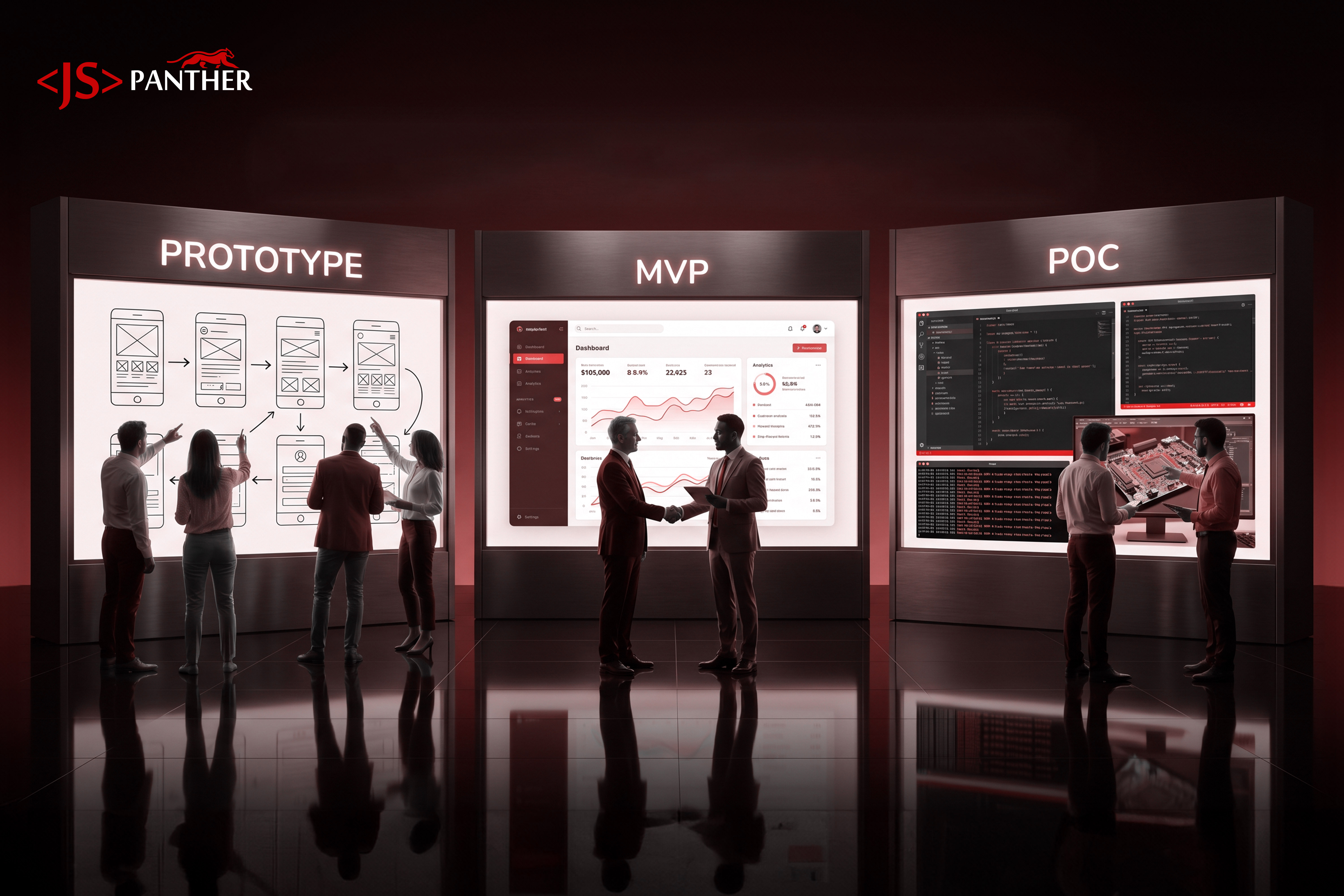
This is also where MVP vs Prototype vs PoC becomes clearer. A PoC validates technical feasibility. A prototype validates product experience. An MVP validates real market demand.
MVP vs Prototype vs PoC: Key Differences
| Factor | PoC | Prototype | MVP |
| Main Goal | Validate technical feasibility | Validate user experience and workflows | Validate market demand |
| Audience | Internal teams | Investors, stakeholders, focus groups | Real users and customers |
| UI/UX Quality | Minimal | Moderate to polished | Production-ready basics |
| Time Required | Days to weeks | Few weeks | Several weeks to months |
| Technical Complexity | Focused on backend feasibility | Focused on design and interaction | Full product workflows |
| User Feedback | Internal technical validation | Early usability feedback | Real behavioural data |
| Best Use Case | Complex technical uncertainty | Product demonstrations | Market launch and learning |
The Hidden Cost of Starting Incorrectly
One thing founders rarely discuss openly is how expensive poor sequencing becomes.
For example:
Building an MVP before validating technical feasibility can lead to architecture rebuilds.
Building a prototype without understanding market demand can create misleading investor confidence.
Skipping validation entirely often leads to products that users never adopt.
Even overall MVP development cost becomes harder to control when businesses rush into full-scale development too early.
The smartest startups usually spend more time validating assumptions before scaling engineering investment.
That approach feels slower initially.
But it usually accelerates product maturity later.
Final Thoughts
The conversation around MVP vs Prototype vs PoC is not just about software terminology. It is about reducing business risk intelligently. Each stage serves a different purpose. PoC validates feasibility. Prototype validates experience. MVP validates demand
And choosing the correct sequence can dramatically improve how efficiently your product evolves. Some startups only need one of these stages.
Others need all three. The key is understanding what uncertainty you are actually trying to reduce first.
Frequently Asked Questions
When should a startup choose a PoC instead of an MVP?
A startup should choose a PoC when the main goal is testing technical feasibility.
How does a prototype help during product development?
A prototype helps visualise the product. It tests user flows. You can use it to identify usability issues.
Why is user feedback important in MVP development?
User feedback helps businesses validate demand. It paves the way to improve features. It also helps to understand real customer behaviour.
How do I choose between a PoC, prototype, and MVP for my product?
The right choice depends on what uncertainty you are trying to reduce first. If you are unsure whether the technology can actually work, start with a PoC.
If the technical side is clear but you need to visualise the product experience, build a prototype.
If you are ready to test the product with real users and validate market demand, move forward with an MVP.