Agentic AI vs Automation: What’s the Difference?
Last Updated on
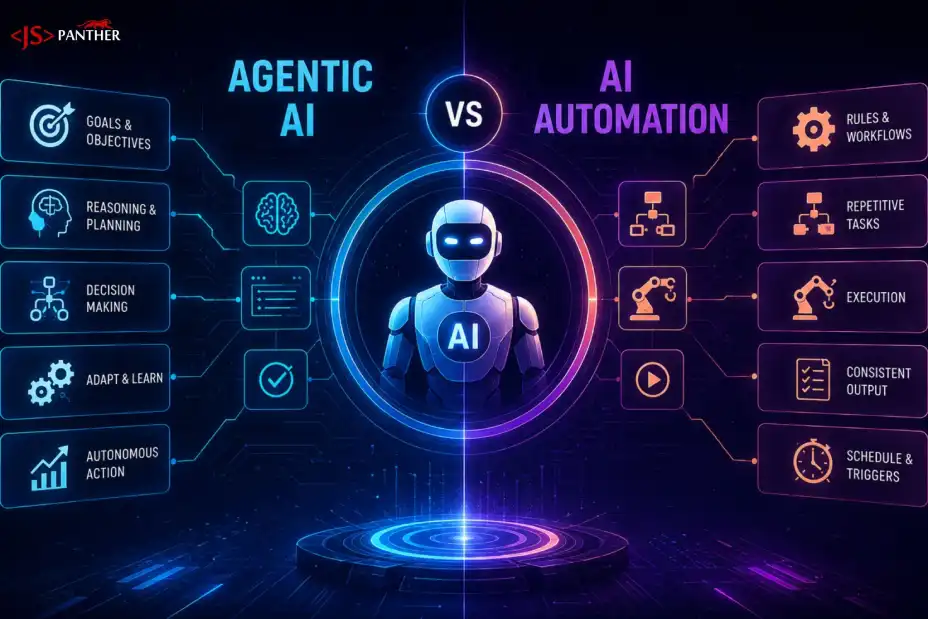
Agentic AI is designed to analyse information, interpret its context, and further come up with the steps to reach the ultimate goal. Whereas, automation is set to follow a predefined workflow involving trigger based instructions.
In simple terms, automation begins with a workflow, and Agentic AI starts with an objective. Automation is based on predefined logic to perform a process, whereas intelligent AI agents have the potential to assess the situation, reason about the next step and further adapt their actions to work towards the outcome. Let us get a better understanding of Agentic AI vs Automation with the help of this segment.
How Does Traditional Automation Work in Business?
Automation is the use of technology for performing tasks or processes with the least possible human intervention. When a business has various repetitive tasks, it can use automation to complete the same steps repeatedly without an employee manually performing them.
Automation particularly works well for structured, repetitive, and predictable processes. Here the rules are established in advance, which lets the system know the action to take when such an event occurs.
Traditional automation follows a predefined sequence of events, i.e., trigger – rule/condition – action – outcome. The process is started with a trigger, after which the system checks predefined conditions and further performs the corresponding actions.
For example:
Trigger – A person completed an online purchase
Condition – Payment successful
Action – Asked to generate an order confirmation and send it to the customer
Outcome – The person receives confirmation automatically
In this scenario, the workflow has been designed by an expert, and the automation system simply follows and executes it. Automation tends to work best when the process is predictable.
How Agentic AI Helps Businesses Handle Complex Tasks?
Agentic AI refers to AI systems that are designed to work for a specific goal by analyzing the situation, reasoning about possible actions, further planning tasks, and ultimately taking action with the help of the available tools.
Intelligent AI agents can determine the steps required depending upon the objective and the information, unlike workflow automation.
The workflow of AI-powered agents turns out to be a continuous cycle of understanding, reasoning, planning, acting, and evaluating. And all this follows the simplified flow, i.e., goal – understand – reason – plan – act – evaluate – adjust.
For example: A person reports that he was charged twice. This would act as trigger, after which a well-designed AI agent would carry out the below tasks:
- Go through the complaint and understand its context
- Verify the transaction records to ensure that the complaint is correct
- Identify the duplicate charges mentioned in the complaint
- Check if that is applicable for any sort of refund
- If a refund is approved in such scenarios, then it will initiate a refund
- And reach the end goal by informing the customer regarding the action taken
What are the Core Differences Between Agentic AI and Automation?
The core purpose of AI agent development and workflow automation is to successfully eliminate manual work from business operations up to a certain extent. However, traditional automation works based on rules set already as per triggers, but AI agents are designed to not just react but to take necessary action by interpreting, adapting and ultimately making any necessary decisions.
1. Rule-Based Execution vs. Goal-Oriented Behaviour
One of the core differences between the two technologies is that Automation is instruction-driven and Agentic artificial intelligence is goal-driven. The automation executes the given instructions consistently, and when something happens outside that, the workflow might stop or would require human intervention.
2. Fixed Workflows vs. Dynamic Workflows
As Agentic AI has the potential for reasoning, it automatically makes the workflow dynamic. On the other hand, automation is more suited for predictable business processes, where there is no requirement for reasoning and a set workflow can be made.
3. Handling Expectations
If you have clear inputs, rules, and expected outcomes, in such a scenario, you will definitely get your expected outcome from automation. However, handling expectations might become difficult when they weren’t considered at the time of workflow design. Whereas, when we discuss AI-powered agents, they can not just analyze the situation but also can determine what is different. They would further gather additional information and try to resolve the issue.
4. Structured Data vs. Contextual
While workflow automation is entirely based on structured data provided by the businesses, AI agents are more inclined towards contextual understanding. You can expect Agentic AI to interpret even if the data entered isn’t a predefined trigger, but that is not applicable in case of automation.
5. Reactive Execution vs. Proactive Action
Agentic AI has the ability to understand and identify what should be the next step, which makes it more proactive. While traditional automation majorly works by reactive theories.
What are the Real-Time Use Cases of Agentic AI and Automation?
The majority of businesses have already incorporated AI agent development and Automation in their business functions to reduce manual effort, improve response time, and further streamline operations. However, depending upon the complexity of the task, the applications for each business differ.
Let us evaluate the practical use cases of both technologies:
1. Customer support
Automation: In this case, rule-based workflows can be incorporated by businesses to simply send instant acknowledgements, route support tickets, order status updates, and other predefined responses to customer queries.
Agentic AI: If your business somewhat requires a technology to understand what customer actual intent is and further carry out the review of account information or identify the issues and proceed with necessary action, then AI agents can definitely do that for you.
2. Sales and Lead qualification
Automation: Here, traditional systems can be used to automatically capture leads from a website and further add them to a CRM and further send follow-up emails based on predefined conditions.
Agentic AI: One can expect an AI agent to analyze leads and gather information like previous interactions, requirements, and engagement behavior to determine whether the lead carries any potential or not. Later on, it can also prioritize the lead, personalize the outreach, update the CRM, and also suggest whether there is a need for human sales involvement or not.
3. Finance and Invoice processing
Automation: Workflow automation can extract predefined invoice information, tally invoices with purchase orders, route them for approval, and even send notifications for payments.
Agentic AI: When you incorporate an Autonomous AI system, it can replace your manual process of reviewing invoices, looking for discrepancies, tallying information, and even look in deep for unusual charges ascertain if the invoice is ready for approval or not.
The role of AI-powered solutions can be endless, especially when we talk about real-world business environments. Industries like IT support, HR management, data research, marketing, and many more have so many use cases for AI solutions. Businesses looking to adopt artificial intelligence can turn to AI consulting companies in Raleigh for better strategy, implementation, and integration.
How can businesses combine Agentic AI with Automation?
While we have evaluated Automation vs Agentic AI in detail in this segment, it is essential to understand that Agentic AI and Automation do not have to operate as separate technologies mandatorily. As per business requirements, they can be combined to create intelligent, end-to-end workflows, where AI agents handle interpretation, reasoning and decision-making, letting the automation manage repetitive and rule-based execution.
You can partner with an AI development company in Raleigh and ask them to design AI agents to decide what should happen and let automation perform those predefined actions to make that happen. The concept of combining the two technologies divides the responsibilities and works best for processes where some stages are predictable and others require decision-making.
Wrapping Up!
Though Agentic AI and automation work differently, the ultimate goal is to ease the business processes. The choice between the two completely depends upon the business requirements, complexity, challenges, and, of course, desired outcome. All you need is to partner with the right AI development company in Raleigh.
FAQs
Q1. What are the limitations of traditional automation?
Automation is ideal for structured, predictable processes but can struggle when situations require context, judgment, or frequent changes. If a workflow has many exceptions or requires decisions based on changing information, businesses may need a more intelligent approach.
Q2. How secure is business process automation?
Automation can be highly secure when designed with appropriate security controls. Businesses can protect automated workflows using role-based access, data encryption, authentication, permissions, audit logs, and continuous monitoring.
Q3. Can AI Agents make decisions on behalf of a business?
If the task or decision falls under the set permissions, an AI agent can definitely make a decision on behalf of a business.
Q4. How long does it take to develop an AI agent in?
While the time taken depends upon the project complexity, in general, a simple AI agent would take around 3–6 weeks of development time. Whereas a custom business agent with a handful of integrations might take up to 6–12 weeks of time or even longer.
Q5. How much do AI agents and automation cost in USA?
According to the current market estimates, a simple AI agent or automation would cost around $3,000–$15,000. Moreover, a custom AI agent with business system integration would range from $15,000 to $75,000 and even higher in more advanced enterprise cases.